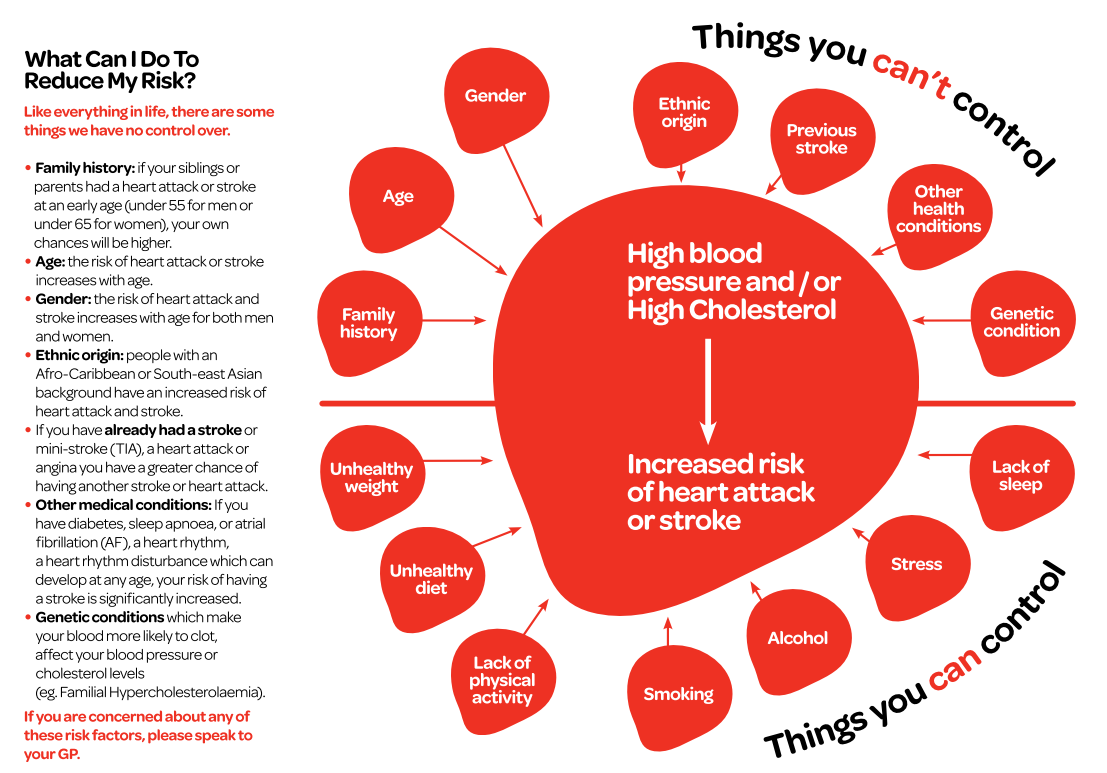
Appendix A. Stroke Factors ↩
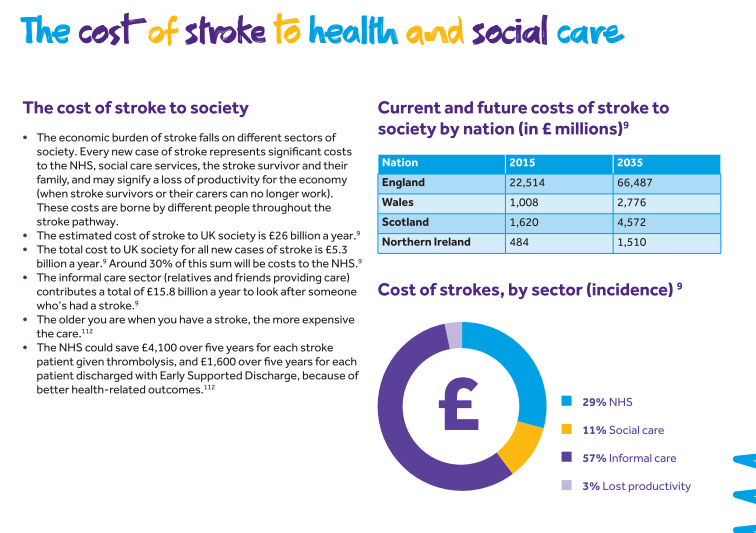
Appendix B. The cost of stroke to health and social care ↩
Appendix C. Canadian Stroke Best Practice evidence rating ↩
Canadian Stroke Best Practice Therapy evidence rating
| Rating | Description |
|---|---|
| A | Evidence from a meta-analysis of randomized controlled trials or consistent findings from two or more randomized controlled trials, where it is obvious the desirable effects outweigh undesirable effects or undesirable effects outweigh desirable effects |
| B | Evidence from a single randomized controlled trial or consistent findings from two or more well- designed non- randomized and/or non-controlled trials, and large observational studies. Desirable effects outweigh or are closely balanced with undesirable effects or undesirable effects outweigh or are closely balanced with desirable effects. |
| C | Writing group consensus and/or supported by limited research evidence. Desirable effects outweigh or are closely balanced with undesirable effects or undesirable effects outweigh or are closely balanced with desirable effects, as determined by writing group consensus. Recommendations assigned a Level- C evidence may be key system drivers supporting other recommendations, and some may be expert opinion based on common, new, or emerging evidence or practice patterns. |
Canadian Stroke Best Practice Therapy evidence level.
| # | Specfic Therapy | Evidence Level |
|---|---|---|
| i | ROM exercises (passive and active-assisted) that includes placement of the upper limb in a variety of appropriate and safe positions within the patient’s visual field should be provided. Refer to Recommendation ‘‘Recommendations on management of shoulder pain and complex regional pain syndrome (CRPS) following stroke’’ for additional information. |
Level C |
| ii | Following assessment to determine if they are suitable candidates, patients should be encouraged to engage in mental imagery to enhance upper-limb, sensorimotor recovery. |
Early-Level A; Late-Level B |
| iii | Functional Electrical Stimulation (FES) targeted at the wrist and forearm muscles should be considered to reduce motor impairment and improve function. |
Early-Level A; Late-Level A |
| iv | Traditional or modified constraint-induced movement therapy should require consideration for a select group of patients who demonstrate at least 200 of active wrist extension and 100 of active finger extension, with minimal sensory deficits and normal cognition. |
Early-Level A; Late-Level A |
| v | Mirror therapy requires consideration as an adjunct to motor therapy for patients with very severe paresis. It may help to improve upper extremity motor function and ADLs. |
Early-Level A; Late-Level A |
| vi | Despite mixed evidence, sensory stimulation (e.g. transcutaneous electrical nerve stimulation, acupuncture, biofeedback) can be considered as an adjunct to improve upper extremity function. |
Evidence Level B |
| vii | Virtual reality, including both immersive technologies such as head-mounted or robotic interfaces and non- immersive technologies such as gaming devices can be used as adjunct tools to other rehabilitation therapies as a means to provide additional opportunities for engagement, feedback, repetition, intensity, and task- oriented training. |
Evidence Level: Early-Level A; Late-Level A |
| viii | Therapists should consider supplementary training programs aimed at increasing the active movement and functional use of the affected arm between therapy sessions, e.g. Graded Repetitive Arm Supplementary Program suitable for use during hospitalization and at home. |
Evidence Level: Early-Level B; Late-Level C |
| ix | Strength training requires consideration for persons with mild to moderate upper extremity impairment for improvement in grip strength. Strength training does not aggravate tone or pain. |
Grip strength; Early-Level A; Late-Level A, Strength training; Level A |
| x | Bilateral arm training is not recommended over unilateral arm training to improve upper extremity motor function. |
Level A |
| xi | Non-invasive brain stimulation, including repetitive transcranial magnetic stimulation (rTMS) and transcranial direct current stimulation (tDCS) could be considered as an adjunct to upper extremity therapy. |
Level A (rTMS); Level B (tDCS) |
| xii | For patients who are unable to produce any voluntary muscle activity in the affected upper limb, the patient (and caregiver) should be taught compensatory techniques and be provided with adaptive equipment to enable basic ADLs. It is reasonable to continue teaching compensatory techniques until the patient can manage basic ADLs independently or until recovery of active movement occurs. |
Adaptive equipment to enable basic ADLs (Evidence Level B). until recovery of active movement occurs (Evidence Level C). |
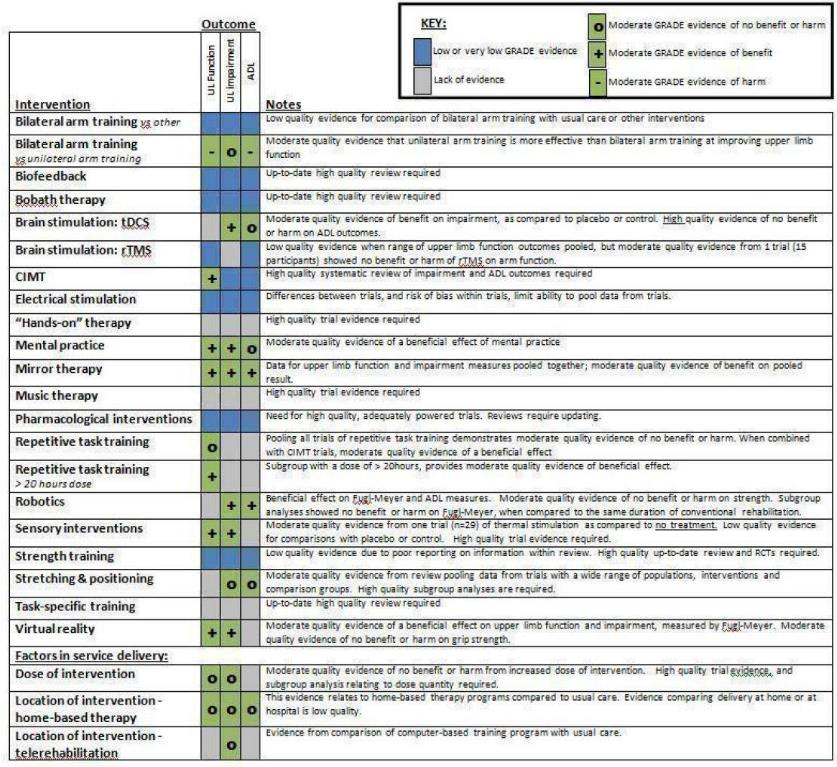
Appendix D. Intervention, grade of evidence for Outcome ↩
Appendix E. Queens Square Upper Limb Fugl-Meyer Results ↩
Appendix F. Queen Square UL Summary ↩
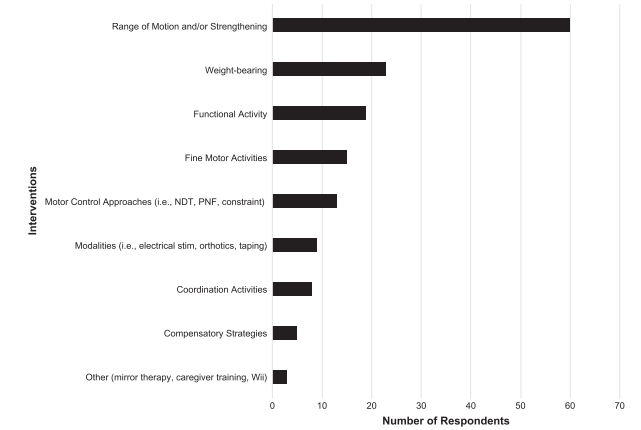
Appendix G. Interventions reported as used in upper extremity home programs ↩
Appendix H. Measurements ↩
Physical Upper Extremity Measurements
- ABILHAND, Action Research Arm Test (ARAT)
- Box and Block Test (BBT)
- Chedoke Arm and Hand Activity Inventory (CAHAI)
- Chedoke-McMaster Stroke Assessment, Disabilities of the Arm
- Shoulder and Hand (DASH)
- Frenchay Arm Test (FAT)
- Leeds Adult Spasticity Impact Scale (LASIS)
- Motor Evaluation Scale for Upper Extremity in Stroke Patients (MESUPES)
- Nine Hole Peg Test (NHPT)
- Purdue Pegboard Test (PPT)
- Stroke Arm Ladder, Stroke Impact Scale (SIS)
- Upper Extremity Function Test (UEFT)
- Wolf Motor Function Test (WMFT)
Stroke Severity Measurements
- Canadian Neurological Scale (CNS)
- Charlson Comorbidity Index (CCI)
- Modified Rankin Scale (MRS)
Activities of Daily Living Measurements
- ADL Profile, Assessment of Motor and Process Skills (AMPS)
- Barthel Index (BI)
- Frenchay Activities Index (FAI)
- Functional Independence Measure (FIM)
- Multiple Errands Test (MET)
- Reintegration to Normal Living Index (RNLI)
- Screening for Self-Medication Safety Post-Stroke Scale (S-5)
- Stroke Impact Scale (SIS)
Cognition Measurements
- Cambridge Cognition Examination (CAMCOG)
- Clock Drawing Test (CDT), Color Trails Test (CTT)
- Executive Function Performance Test, Kettle Test (KT)
- Mini-Mental State Examination (MMSE)
- Montreal Cognitive Assessment (MoCA)
- Multiple Errands Test (MET), Trail Making Test (TMT)
Mood/ Depression Measurements
- Aphasic Depression Rating Scale (ADRS)
- Beck Depression Inventory (BDI, BDI-II)
- General Health Questionnaire (GHQ- 28)
- Geriatric Depression Scale (GDS)
- Hospital Anxiety and Depression Scale (HADS)
- Montgomery Asberg Depression Rating Scale (MADRS)
- Patient Health Questionnaire (PHQ-9)
- Stroke Aphasic Depression Questionnaire (SADQ)
Quality of Life Measurements
- Medical Outcomes Study Short Form 36 (SF-36)
- Stroke Specific Quality of Life Scale (SS-QOL)
- Stroke-Adapted Sickness Impact Profile (SA-SIP30)
System Measurements
- Immersive Tendencies Questionnaire (ITQ)
- Presence Questionnaire (PQ), Simulator Sickness Questionnaire (SSQ)
- User Experience Questionnaire (UEQ)